Styling a Small HDB Apartment Without Making It Feel Crowded: A Singapore Guide to Light-Luxury Wood Furniture
I spent last month visiting two friends who had just collected the keys to a 4-room Build-to-Order flat in Punggol. Both were staring at the same empty 93 sqm floor plan and the same HDB guideline packet, complaining that every shop in Tampines Martians Mall and Bedok furniture stretch along Bedok North Road threw the same two options at them: a glossy three-piece compressed-board sofa set for S$1,888, or a plain pine bed frame with no colombo. The thing they actually wanted was a calm, warm interior that read "small but considered" — the kind of room where the eye rests on a piece of solid wood furniture and stops bouncing off white walls. That is the heart of this brief. If you live in a Singapore HDB flat, a 538 sqft condo in Punggol, or a 506 sqft shoebox unit near the MRT, the furniture you choose does the heavy lifting, because the walls are usually fixed in white or magnolia and the floor is fixed in compressed vinyl or porcelain tile. Get the furniture wrong and every centimetre feels occupied; get it right and 65 sqm reads like 80.

Over the past ten years I have watched the same mistake repeated across Tampines, Bedok, Sengkang, and Punggol flats: the owners fill the space with too many pieces, each too big, each in a different wood finish that fights the next. The fix is rarely a bigger flat. It is a smaller shopping list, a tighter palette, and an honest conversation about lift widths, corridor clearances, and the 9% GST line on your delivery invoice. Everything below is written for that conversation.
What "crowded" actually looks like in a Singapore HDB flat
Crowded is not the same as full. A 4-room BTO with a queen-size bed, a 1.6m dining table, a three-seat sofa, and a wardrobe is fully furnished but not crowded, provided each piece has at least 70cm of breathing room on every visible side. Crowded is what happens when you push a 2.2m floor-to-ceiling wardrobe against a wall that already carries a 1.8m bookcase, then add a 1.4m coffee table on top of a 2m rug so the circulation path shrinks to 45cm. I have walked into a Tampines resale flat where the corridor between the dining table leg and the kitchen counter was 38cm — a non-Singaporean friend would simply not be able to pass during a makan session.
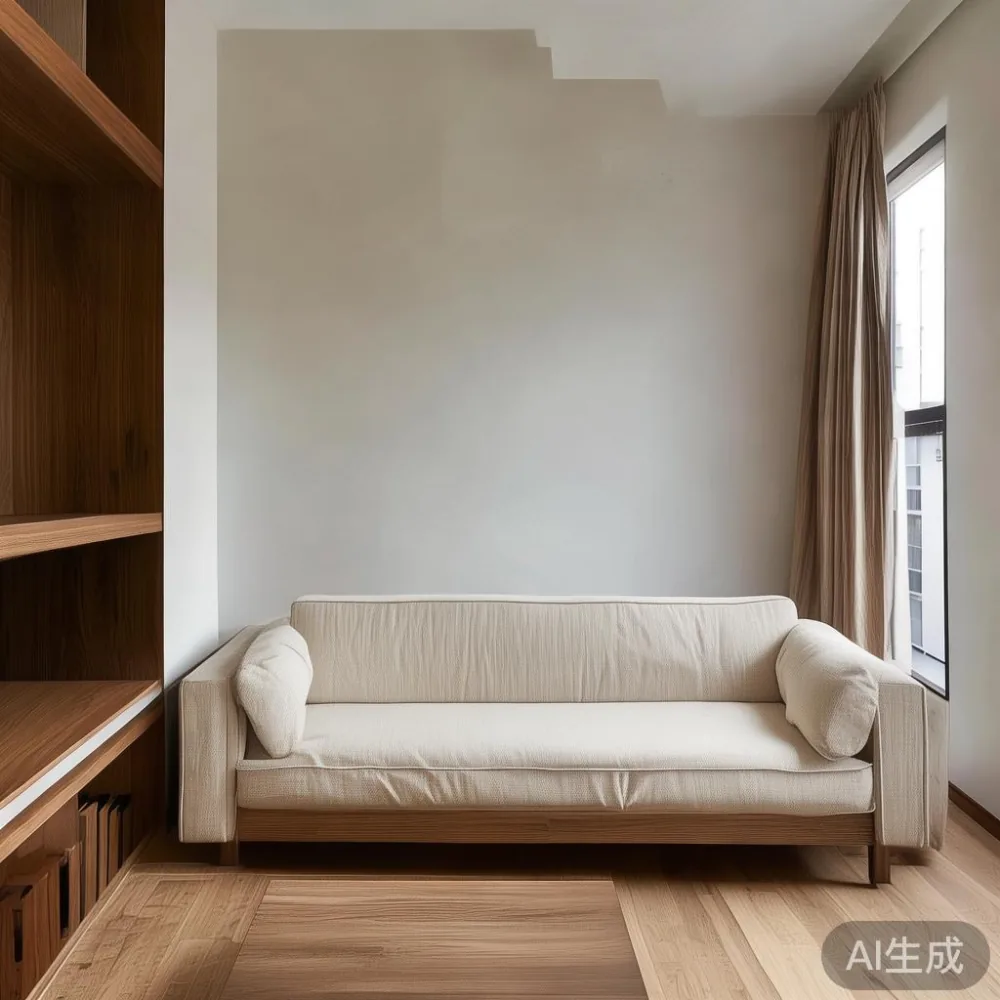
Singapore-specific triggers most people underestimate are the lift and the corridor. A standard HDB passenger lift cargo inner is roughly 1.4m deep by 1.1m wide with a 630kg limit. A solid wood sofa in a single carton often weighs 78kg and arrives in a 2.15m long, 0.95m wide box. It just fits, with 2cm to spare on the long axis, and only if the driver tilts the carton on its side. The corridor outside your flat door is typically 1.2m to 1.5m wide, which means a 2.1m tall wardrobe delivered assembled will not turn the corner on level 12 unless you book the service lift. These constraints are why "small apartment" furniture in Singapore is its own genre, and why a Foshan-trained maker shipping flat-pack, knock-down solid wood furniture with explicit carton dimensions is worth the call.
Notice what the crowded-room examples all have in common: every piece is loud. Gloss, two-tone laminate, brass studs, tufted velvet — all of them shout at once. Calm interiors work the opposite way. They pick one wood finish, repeat it, and let the architecture breathe.
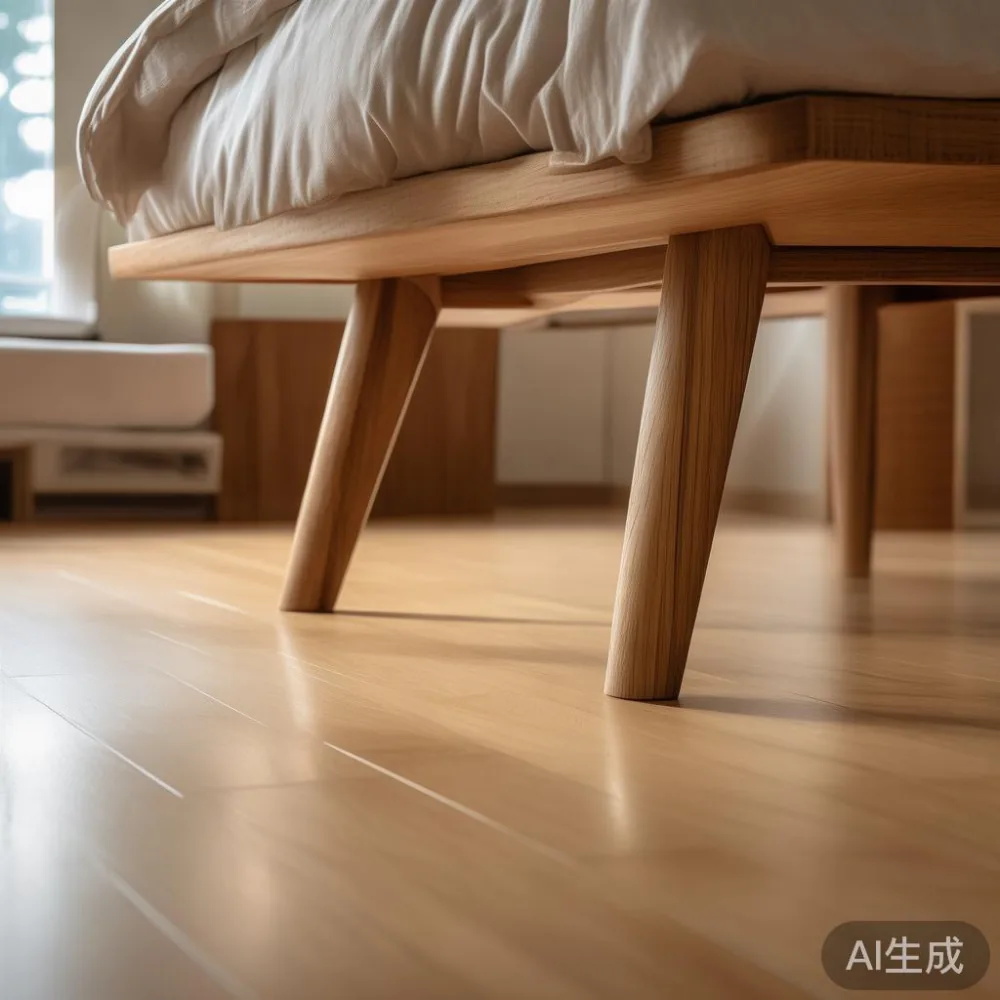
How do I pick a wood finish that does not fight my white HDB walls?
Pick one finish and stay there. That is the short answer. The slightly longer answer is: pick a warm, mid-tone wood finish — walnut, light oak, ash — and use it on every major piece so the eye reads them as one continuous layer of material, not five separate purchases. In a 4-room flat with white walls, off-white ceilings, and grey compressed-vinyl floors, a walnut solid wood sofa on a walnut TV console on a walnut dining table reads as furniture. A walnut sofa on a black-laminate TV console on a pale-oak dining table reads as a moving sale.
The reason a single wood finish works in small rooms is a visual phenomenon called figure-ground grouping: when adjacent pieces share colour, your brain merges them into a single mass and the room reads as larger. When they differ, your brain treats each as a separate object and the room reads as busier, even when the floor area is identical. The matte, open-pore walnut finish that most Foshan factories now apply to their American light luxury collections does this very well because the grain is visible but quiet. It absorbs light instead of bouncing it back, which is what you want when every surface in an HDB flat already wants to reflect the downlights.
For a 65 sqm flat in Bedok Reservoir, I would lock the palette to walnut on the bed frame, dining table, TV console, and nightstands; introduce one contrast piece in marble (a small round marble table, 55cm diameter, in the living room corner); and leave the wardrobe either in the same walnut or in a hand-painted soft-grey with a single walnut pull-bar so it visually disappears into the wall. Two finishes total, three if you count the marble as its own category, and the room will feel edited rather than edited-and-then-edited-again.
What size sofa and dining table will my lift actually accept?
This is the question I get most often, and it is the question that decides whether a "perfect" piece ends up in your living room or stranded at the foot of the service lift on level 4. Measure three things before you buy anything: the inner lift car width and depth (ignore the door), the corridor turn at your floor, and the width of your front door including the frame, which on most HDB flats is exactly 0.9m wide and 2.1m tall.
A three-seat solid wood sofa at 2.1m long, 0.9m deep, with the backrest attached, will need a 2.15m long carton. Most HDB lifts can take a 2.1m length on its side. The weight is the second constraint: a solid ash three-seater with a real rubberwood frame and pocket-spring seats sits between 72kg and 95kg depending on upholstery. Pair it with a 1.4m to 1.6m dining table that, when knocked down, ships in two cartons of about 28kg each. None of these is a problem for a standard lift, but a 1.9m dining table in one carton is a problem, because the carton exceeds 1.85m and the driver will refuse to angle it past the lift ceiling rails.
The dining table height should sit at 75cm for ergonomic reach at a Singapore hawker-table-style chair height of 45cm. The table top thickness for a solid wood top should be at least 3.5cm so it does not warp in our 86% average humidity. Anything thinner and you will see cupping within twelve months. Anything thicker and the table top weighs more than the apron frame it sits on, which is bad engineering. If a sales associate quotes you a 6cm "solid wood top" for under S$900, ask which species and where it was kiln-dried.
Is Italian light luxury bed worth it for a 4-room BTO?
For a 4-room BTO in Tampines GreenRidges or Punggol Northshore, the question of whether Italian light luxury bed worth it is worth the spend usually comes down to two things: the headboard height, and the under-bed clearance. Italian light luxury tends to mean a low-profile platform bed, often 95cm to 105cm total height including a 65cm upholstered headboard, with a 25cm to 30cm under-bed clearance so robotic vacuums can clean. In a master bedroom that measures 3.2m by 3.0m, a queen at 1.6m by 2.0m leaves 80cm of walk-around on the long sides and 60cm at the foot. That is workable but not generous. A king at 1.8m by 2.0m is not workable in a 3.0m wall, because you will have 60cm on the long sides and 60cm at the foot, and the wardrobe door will not open past the bed corner.
What you pay for with an Italian light luxury bed frame is not the name; it is the headboard upholstery density, the silent-close drawer slides if you choose a storage version, and the wood finish consistency between the headboard surround and the bed legs. A cheap knock-off will have two different walnut tones on the same piece and a headboard panel that sags within eighteen months. A proper one will have the same tone across all visible surfaces and a kiln-dried ash or beech slat system that does not creak. If the unit price is over S$1,400 for a queen, ask to see a swatch of the actual finish in daylight, not under showroom spots.
My own test: I visited a friend's new flat in Punggol last month and watched the same Italian light luxury bed frame arrive in three cartons totalling 96kg. The driver carried two cartons up via the passenger lift and one up the service lift. The bed assembled in 45 minutes with two people and a 10mm Allen key. No squeaks after eight weeks. That is what you should be measuring a purchase against, not the brand label on the brochure.
Is Mid-century modern sofa worth it for a Singapore condo living room?
For a 506 sqft or 538 sqft condo in District 19, the question of whether a Mid-century modern sofa worth it the floor area depends on three measurements — the seat depth, the arm height, and the leg clearance. A Mid-century modern sofa at 1.8m long with a 58cm seat depth, 65cm arm height, and 18cm of leg clearance under the apron will visually float in a small living room in a way a chunky rolled-arm three-seater never will. The 18cm of exposed leg is the trick: it lets light pass under the piece, which makes the floor look bigger and the sofa look lighter. The reason is the same as the wardrobe question: visible floor equals larger-feeling room.
What makes a Mid-century modern sofa worth it for HDB living rooms is the seat-firmness-to-cushion-thickness ratio. A 12cm seat cushion on a pocket-spring base will keep its shape after eight hours of sitting; a 15cm high-resilience foam cushion on a webbing base will sag within a year. Ask which one you are getting. Both feel firm in the showroom, both feel different after week 52.
A light-luxury version of a Mid-century modern sofa pairs a walnut frame with a bone-coloured woven fabric and brass-tipped legs. That combination — solid wood sofa frame plus textured fabric plus small metal accent — is the French light luxury reading of the form, and it works in Tampines, Bedok, and Punggol because it does not lean too hard on either American mid-century nostalgia or French provincial ornament. A 1.95m version of this sits comfortably in a 3.4m by 3.2m living room with a 1.2m walnut TV console and a 55cm marble table in the corner. The total furniture spend for this trio can sit between S$3,400 and S$5,200 depending on fabric grade.
Japanese bed vs French provincial bed: which suits a Singapore HDB master bedroom?
The Japanese bed vs French provincial bed question comes up at least once a week from HDB owners in their late thirties, and the honest answer depends on ceiling height and storage need. A Japanese platform bed is 28cm to 35cm off the floor, has no headboard or a 30cm low headboard, and trades vertical drama for floor visibility. In a 2.8m HDB ceiling, a low Japanese bed reads as a meditation surface; the eye sees 2.45m of uninterrupted air above it. A French provincial bed is 110cm to 125cm tall including a 70cm to 80cm carved or upholstered headboard, sits on cabriole or turned legs, and trades floor visibility for a single tall point of focus on one wall.
For a 3.0m by 3.2m master bedroom in a Punggol BTO, the Japanese bed wins if you store under the bed and want the room to feel airy. The French provincial bed wins if you have a separate storage wardrobe and want one statement piece on the headboard wall. What does not work is a French provincial bed in a 2.7m by 2.9m second bedroom — the headboard eats the wall and the cabriole legs trap dust that your robotic vacuum cannot reach. Pick the form to fit the room, not the form to fit the mood.
Light-luxury versions of both exist, and both work. A Japanese-style ash platform with a 5cm headboard and an 8cm leg is the kind of piece that disappears into a small room in the way a flat should. A French provincial headboard in a single walnut finish, with the carvings softened and the cabriole legs replaced by straight tapered legs, gives you the French provincial silhouette without the French provincial clutter. The clean-line version is what most Foshan makers ship under the post-modern light luxury label, and it is the one that survives the move from showroom to HDB corridor to bedroom wall.
How to choose light luxury wardrobe without losing floor space?
The honest answer on how to choose light luxury wardrobe without losing floor space starts with door clearance and ends with internal layout. A 1.8m wide by 2.1m tall by 55cm deep wardrobe in solid ash with sliding doors takes up exactly 1 sqm of floor and gives you 1.98 cubic metres of storage. A 2.0m wide by 2.2m tall by 60cm deep hinged-door wardrobe takes up 1.2 sqm of floor and gives you 2.64 cubic metres of storage but adds 0.55m of swing arc on the front. In a 3.0m by 3.2m bedroom, the swing arc eats 18% of the usable floor, which is the difference between fitting a nightstand on the side of the bed or not.
Sliding doors win for small rooms. Two soft-close sliding doors on an aluminium top track at 1.8m wide will run you between S$1,950 and S$2,800 for a 55cm deep unit in a Foshan-made solid ash carcass with an 18mm back. Anything under S$1,500 at that depth is almost certainly 12mm MDF wrapped in a paper laminate, and the back panel will bow within twenty-four months in Singapore humidity. Open the back panel spec sheet before you pay.
The internal layout is where the money goes. A proper light-luxury wardrobe gives you a 110cm hanging zone for long dresses, a 90cm hanging zone for shirts, three 45cm wide drawers on full-extension soft-close slides rated to 45kg, four adjustable shelves, and a pull-out trouser rack. If your quote shows fewer than these components, the savings are coming out of the carcass, not the brand.
How to style European light luxury wardrobe in apartment so it does not dominate the room?
The cleanest answer on how to style European light luxury wardrobe in apartment so it does not dominate the room is to match the wardrobe finish to the wall finish as closely as possible, then break the match with a single accent. A pale-grey painted wardrobe against a pale-grey HDB wall disappears into the wall; the eye reads the room as one continuous plane and the floor looks bigger. A pale-grey wardrobe against a white wall reads as a grey block. A white wardrobe against a white wall reads as an architectural feature. Pick the read you want, then choose the finish.
European light luxury wardrobes tend to come in three silhouettes: full-height hinged, full-height sliding, and floor-to-ceiling with a 12cm pelmet to the ceiling. For HDB ceilings of 2.7m to 3.0m, the floor-to-ceiling pelmeted version wins, because it hides the 5cm to 10cm gap that builders leave above wardrobes and gives you one clean line. Add a single vertical pull-bar in brushed brass at 110cm from the floor and the piece reads as a designed object, not a built-in afterthought. Pair it with a European light luxury dressing table at 120cm long, 45cm deep, and 75cm tall, with three drawers and a tilt mirror, and the corner becomes a usable vanity without becoming a clutter zone.
What I recommend to Punggol and Bedok owners with 65 sqm to 80 sqm flats is one continuous material story: walnut bed frame, walnut nightstand, walnut dressing table legs, grey painted wardrobe with one walnut pull-bar, and a 55cm marble table in the living room corner for the only contrasting material in the room. The marble table earns its 0.3 sqm of floor by being the single point of contrast in an otherwise wood-led palette, which is what makes the room feel curated instead of crowded.
What does a typical MIDHILL order look like from cart to corridor?
For a Tampines or Bedok HDB owner, what a typical MIDHILL order looks like from cart to corridor runs like this. You pick a solid wood sofa, a queen-size bed frame, a 1.6m dining table, a 1.8m sliding-door wardrobe, two nightstands, and a 55cm marble table. The pieces ship from Foshan over 18 to 28 days, free above US$350, which translates to roughly S$480 and is easy to clear with a four-piece order. The cartons arrive on a 1.5-tonne lorry with a tail lift and two delivery men who call 30 minutes ahead. The 10-year structural warranty is registered against your flat address, the lifetime refinishing benefit is on file against your order number, and the 14-day return window starts the day the last carton is signed for.
The reason I mention the warranty and refinishing terms in a styling piece is that they actually shape what you should buy. A 10-year structural warranty on a solid wood sofa means the factory expects the frame to outlast the fabric by a decade, so you should pick a fabric you can reupholster locally for S$280 to S$420 per seat instead of choosing the cheapest fabric on the swatch card. The lifetime refinishing benefit on the bed frame and dining table means a scuff in year six is a S$0 fix, not a S$1,200 replacement. That math pushes you toward a more expensive piece at the start and a cheaper piece to maintain over fifteen years.
MIDHILL furniture, in the context of small Singapore apartments, is built for the carton constraints we discussed earlier. The carton dimensions are on the spec sheet, the weights are on the spec sheet, and the knock-down hardware is sized for an HDB owner with a 10mm Allen key and an hour to spare. That is the practical test for any small-apartment furniture maker shipping into Singapore: does the spec sheet answer the lift question before you have to ask it?
The one-room test that catches 80% of crowding mistakes
Before you pay the deposit, take a tape measure and a roll of masking tape into the room you are furnishing. Mark out the floor footprint of every piece in the order at 1:1 scale, including the door and drawer arcs. Stand in the doorway and read the room the way a guest would read it. If three or more pieces fall inside the same 1.5m by 1.5m visual zone, you are crowding the room. If two pieces fall inside the same visual zone and the rest are spread across the walls, you are styling the room. That is the 80% rule in practice, and it does not require any furniture catalogues or mood boards to apply.
The remaining 20% is the wood finish story we walked through above. Match it, repeat it, and let one marble accent break the rhythm. That combination — correct footprints plus a tight palette — is what turns a 65 sqm HDB flat into a room that feels considered, not crowded. A 93 sqm BTO with a queen-size solid wood bed frame, a 1.95m Mid-century modern solid wood sofa, a 1.6m dining table, a 1.8m sliding wardrobe, two nightstands, and a 55cm marble table will read as a home, not a showroom floor. The lift will accept it, the corridor will accept it, and the 9% GST on the delivery invoice will be the only number that feels crowded.