Warm Minimal in Singapore: Matching Solid Wood Furniture to a Calm, Cosy Home
If you have walked through a freshly renovated 4-room HDB flat in Punggol or a 99-year condo in Bedok lately, you have probably noticed the same quiet shift on the feed. Walls are painted in milky off-white. Floors are pale, with a hint of honey. The sofa is low, the curtains are linen, and somewhere in the corner a piece of solid wood furniture carries the whole room. Warm minimal is no longer a passing Pinterest board in Singapore. It is the default mood for young couples, new BTO owners, and second-home buyers who are tired of stark Scandinavian and bored of glossy post-modern curves. The trick is to keep the calm, but warm it up. That is where a carefully chosen wood finish, a few well-made pieces, and a little restraint become the whole design language.
I spent the second week of last month visiting three showrooms across Tai Seng and Eunos with a friend who had just collected her keys in Tampines GreenRidges. We measured lift openings (about 210 cm tall by 110 cm wide for most HDB passenger lifts, narrower on older blocks), walked narrow corridors, and timed the lift trips up to her 14th floor. None of the walnut or ash dining tables she had saved on her phone actually survived the lift math. The one that did was a 140 cm solid wood dining table in a soft natural wood finish, which the showroom team disassembled into two halves, brought up flat-packed, and re-assembled in her living room in under 40 minutes. That single constraint, lift and corridor width, ended up shaping every other choice she made that week. It is the kind of detail that an online shopping cart never tells you, and it is the reason I want to walk through this topic carefully, the way I would for any client sitting across from me at a desk piled with fabric swatches and floor plans.
What does warm minimal actually look like in a Singapore HDB or condo?
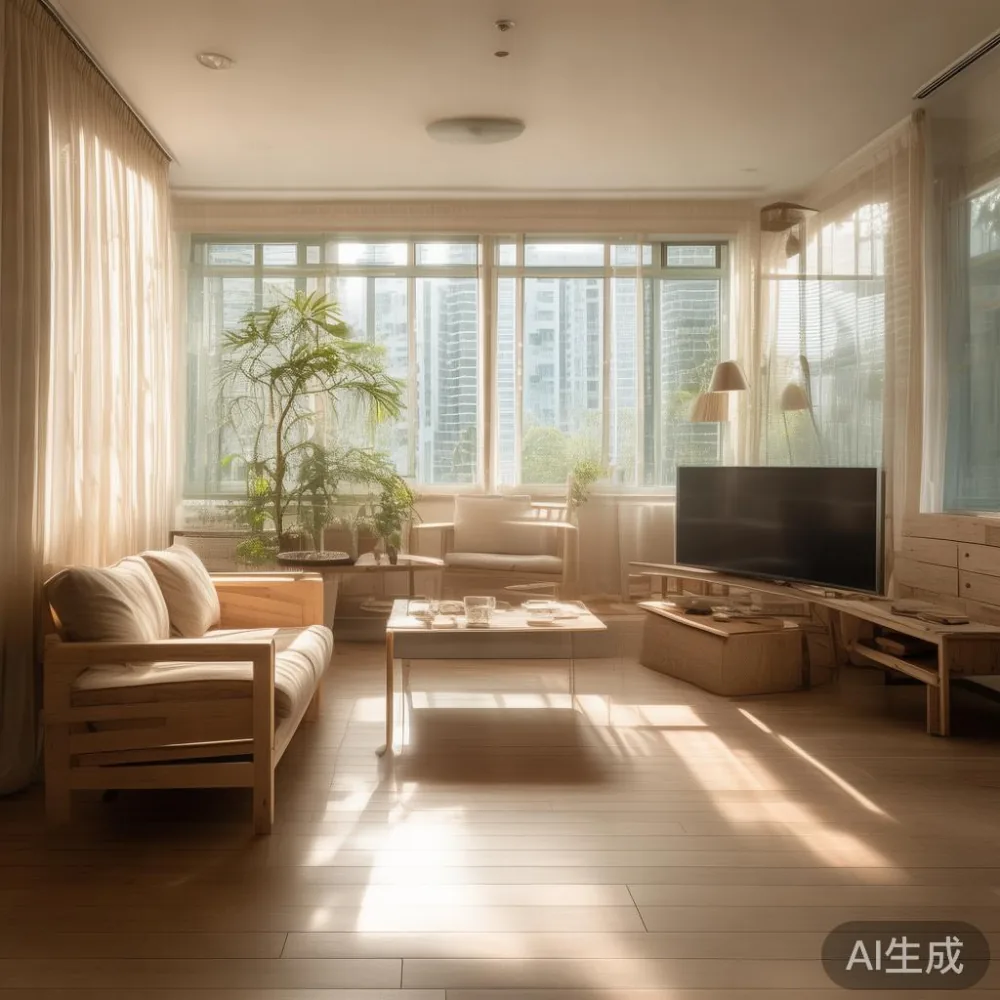
Warm minimal is not cold minimal with a beige throw. It is a specific balance. Picture a 1,000 sqft condo living room with three to four wall colours instead of the usual one. Off-white walls, a slightly darker putty on one feature wall, oak-toned engineered flooring from a local supplier like Floor Xpert or The Floor Gallery at around S$9 to S$14 per square foot, and one tall indoor plant, perhaps a fiddle leaf or a bird of paradise, in a matte ceramic planter. Add a 3-seater solid wood sofa frame at S$1,880 with removable linen-blend cushions, a 120 cm round travertine or marble side table at S$620, and a slim 180 cm TV console in the same wood finish. The room reads warm because the wood carries weight, but it reads minimal because the silhouette is low, the palette is narrow, and the accessories are edited down to one or two objects per surface.
The contrast with a typical Singapore new-launch developer finish is sharp. Developer palettes from the last five years often run grey, charcoal, and white marble. That is fine on handover day, but it leaves a flat, slightly clinical feel. Warm minimal says the floor can stay pale, but the furniture has to be honest material with a visible grain. Ash, white oak, light walnut, and warm-toned ash are the four wood tones I see working again and again in 2025 fitments across Singapore. Among the project references I track, MIDHILL has been specifying those same four wood finishes across its solid wood sofa, bed frame, dining table, wardrobe, and nightstand ranges, which is one reason I keep recommending their catalogue to clients who want quiet, long-lasting pieces rather than loud statement buys.
How do I match a wood finish to my floor and wall without going matchy?
This is the question I get most often, and it is the right one to ask. The old rule was to pick either contrast or harmony. In a warm minimal interior the rule is gentler. Stay within two to three tones of the floor, but never pick the exact same tone. If your floor is a pale 7-inch oak plank at around tone 4 on a 1-10 scale, your furniture should land between tone 5 and tone 7. That puts you in honey ash, natural white oak, or a soft light walnut. A pure black walnut at tone 9 will fight the floor. A whitewashed pine at tone 2 will look anaemic next to it.
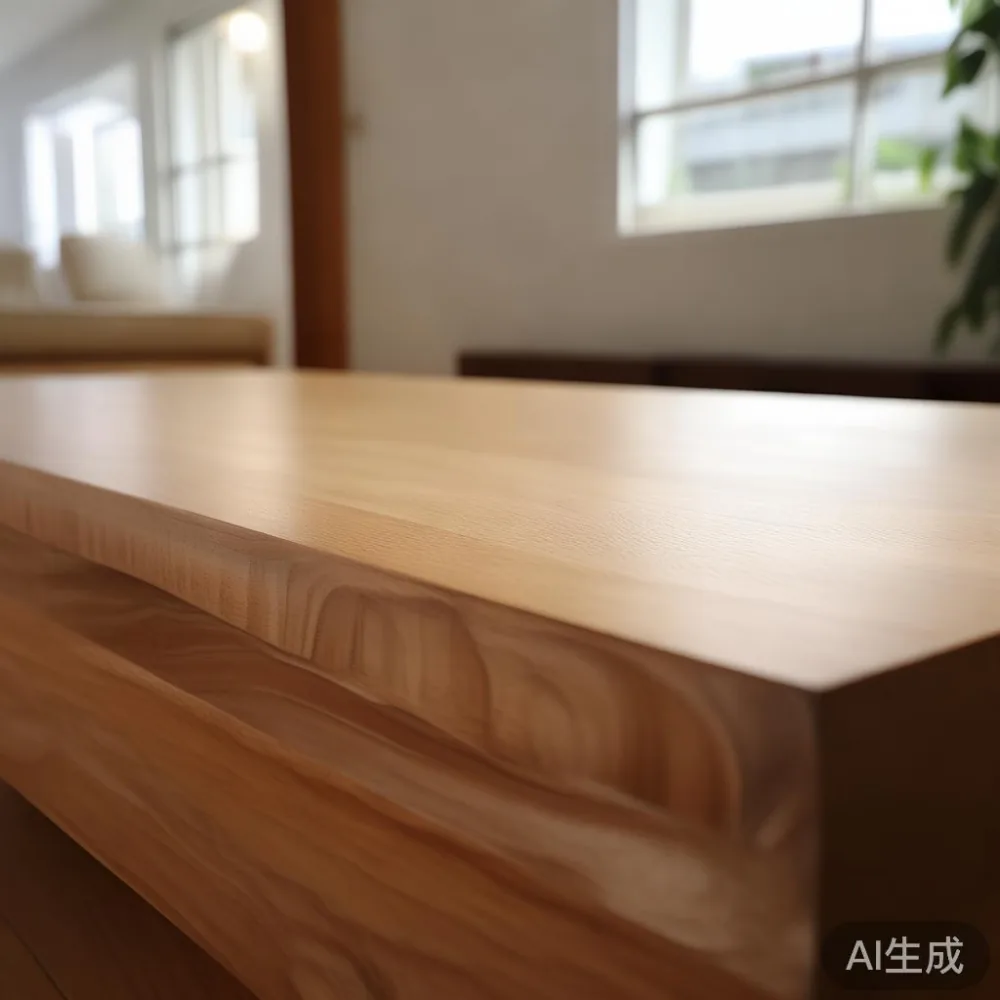
For walls, you have a little more freedom. SCDA paints, Nippon 5001 in Cool Calm, and the popular Korean-brand Amser colours like Soft Linen all sit at tone 2 to 3. They are warm enough to flatter wood but pale enough to disappear. The wood finish on your furniture is the third voice in the conversation, and it should be the loudest of the three. That is why I push clients towards pieces with a clear, open-grain wood finish rather than a high-gloss lacquered surface. The grain catches the afternoon light coming through the east-facing windows in Punggol and Bedok, and the room feels alive by 4pm without you doing anything.
If you are building the room around one hero, a 180 cm to 200 cm solid wood bed frame in honey ash, then your dining table and wardrobe can step one tone darker for quiet contrast. If the bed is already in dark walnut, drop the wardrobe back to ash and let the bed carry the depth. The trick is a tonal stair, not a tonal flat.
Which furniture pieces matter most in a warm minimal Singapore home?
You do not need ten pieces. You need five to seven, picked carefully, in the right scale for an HDB or condo. Here is the short list I build with clients, with realistic Singapore price ranges in SGD for solid wood pieces in 2025.
- Solid wood sofa frame (3-seater, 200-220 cm): S$1,580 to S$2,400. Ask for removable linen-blend cushion covers in oatmeal, sage, or warm clay. A solid wood sofa frame in ash or white oak outlasts MDF frames by 10 to 15 years, and the wood finish can be re-oiled rather than replaced.
- Solid wood dining table (140-160 cm, seats 4 to 6): S$1,150 to S$2,100 for a six-leg or trestle design in ash or light walnut. Round 120 cm versions at S$880 to S$1,280 work for tighter BTO dining corners. Keep legs at 72 to 74 cm so standard dining chairs at 45 cm seat height slide under cleanly.
- Solid wood bed frame (queen, 152 cm x 188 cm or king, 183 cm x 198 cm): S$1,250 to S$2,800. Choose a low platform style, under 35 cm from the floor, with slats spaced under 7 cm so pocket-spring mattresses at 25 to 30 cm tall read at a comfortable 60 to 65 cm final seating height.
- Wardrobe (2-door to 3-door sliding, 180 cm to 240 cm wide): S$1,800 to S$3,600 for a solid wood carcass with a warm wood finish on the outer panels and matte lacquer inside. In a compact HDB bedroom the wardrobe usually sits on the longest wall, so width matters more than depth. 55 cm to 60 cm internal depth is enough for most wardrobes.
- Nightstand (50 cm x 40 cm x 55 cm): S$280 to S$520 each. Two matching nightstands in the same wood finish as the bed frame tie the room together. Skip the drawer version if you already have under-bed storage from your platform bed.
- Marble table (side or coffee, 90 cm to 110 cm): S$620 to S$1,400 for a travertine or warm-toned marble top on an ash or black steel base. This is the one cool material you can introduce without breaking the warm minimal spell. Cream or honey travertine pairs better than white Carrara for this look.
That is the working set. Everything else, side chairs, bookcases, console tables, can be added over three to five years as your budget and your storage needs evolve.
Do light luxury styles actually work in a small HDB, or is it just marketing?
The phrase light luxury gets thrown around a lot, and I used to be sceptical. After two years of specifying it, I think three versions are genuinely useful for warm minimal in Singapore. French light luxury reads as curved silhouettes, soft boucle, cream tones, and a single brass detail, usually a leg tip or a drawer pull. American light luxury is wider, more horizontal, in oak and walnut with cleaner lines and brass cup pulls. Post-modern light luxury pushes curves further, with rounded corners on the bed headboard, kidney-shaped marble tables, and soft pastel upholstery.
What ties all three together, and what makes them work in a 90 sqm HDB, is restraint. Pick one of the three, not two. A friend in Punggol went full French light luxury in her 5-room flat last quarter: a curved ash boudoir-style bed at S$2,650, two boucle armchairs at S$780 each, a 90 cm travertine marble table at S$680, and linen curtains in oat. Total furniture spend around S$7,800, plus a 9% GST on top, and the room looks like a 35 sqm Parisian apartment transplanted into a HDB. The reason it does not feel cramped is the height discipline. The bed headboard stays under 110 cm tall. The armchairs are 78 cm seat height, so they do not block the window. The marble table is round, so the corners of the room stay soft.
If you are curious about how a French provincial for small living room layout differs from a Nordic or American light luxury layout, the simplest test is silhouette and weight. French leans curved and slightly heavier in fabric. American leans straight and heavier in wood. Nordic leans straight and light in both. For warm minimal in a Singapore context, I lean American light luxury for tight condos and French light luxury for slightly larger 4-room or 5-room flats, because the curves need at least 18 sqm of breathing room around them to read as luxury rather than clutter.
Is a solid wood dining table worth the extra spend over a veneer or MDF version?
Yes, but with caveats. A 140 cm solid ash dining table at S$1,480 will outlast a comparable MDF-and-veneer table at S$520 by 8 to 12 years in a Singapore climate. Singapore humidity averages 70 to 85 percent year-round, and air-conditioning pulls indoor humidity down to around 55 to 65 percent for 8 to 14 hours a day. That daily swing of 15 to 25 percent humidity is what destroys MDF edges and lifts veneer seams. Solid wood moves too, but a kiln-dried ash or oak plank with a proper wood finish will move evenly, and any small surface cracks can be sanded and re-oiled in 30 minutes at home. Most local furniture workshops, including the team behind MIDHILL's solid wood sofa and dining table ranges, will refinish pieces they supplied for a small service fee, and some offer lifetime refinishing on structural pieces. That is a meaningful saving over a 15-year period.
The caveat is wood choice. Solid rubberwood at S$650 for the same 140 cm table looks tempting, but rubberwood dents easily and does not take a refined wood finish. Save rubberwood for the inside of wardrobes and kitchen carcasses. Spend on solid ash, oak, or walnut for the visible pieces. If the budget is tight, choose one solid wood hero (a dining table or a bed frame) and let the rest be honest engineered wood with a real wood veneer. A S$680 4-door wardrobe in ash-veneered MDF will look identical to a S$2,400 solid ash wardrobe from across the room, and you can upgrade the doors to solid wood in five years when the household settles.
For the dining chairs, I usually recommend a wood seat with a fabric cushion over a fully upholstered chair. The wood frame survives spilled food, the cushion can be re-covered in a new fabric every four to five years, and you save around S$120 to S$180 per chair against a fully upholstered equivalent.
What about wardrobes and the eternal sliding versus hinged question?
In HDB bedrooms you usually have one wall that is longer than 2 metres. That wall almost always ends up with a wardrobe. Sliding doors win on space because they do not need a 60 cm swing arc, and they are the safer choice in bedrooms narrower than 2.8 metres. Hinged doors win on feel, because they open wider, expose more of the interior, and look more like proper furniture than a built-in. The hybrid that I have been specifying most often in Punggol and Sengkang condos is a 3-door wardrobe, 210 cm wide, with two hinged outer doors and one narrower centre door, finished in the same ash or light walnut as the bed frame.
If you are deciding how to choose French provincial wardrobe hardware for a warm minimal interior, the honest path is to skip the ornate brass handles and choose slim leather pulls, recessed finger pulls, or low-profile bronze cup handles at 96 mm centres. Anything bigger pulls the eye and breaks the minimal line. The wood finish should be a matte oil, not a high-gloss lacquer, so the grain shows. And if you can, ask the maker to use solid wood for the door frames and engineered wood for the panels. That cuts weight, keeps the doors straight in our humidity, and reduces the cost by 18 to 25 percent against an all-solid build.
Inside the wardrobe, plan for 55 cm depth, two hanging zones at 100 cm and 160 cm from the ground, three to four shelves, and at least two soft-close drawers. The total internal volume usually lands between 0.9 and 1.4 cubic metres, which is enough for a couple's main wardrobe in a Singapore climate, especially if you store linen on top and out-of-season bags on the top shelf.
How do I keep warm minimal from tipping into bland or showroom-stiff?
This is the question every client eventually asks, usually three weeks after the movers leave. The answer is texture, not colour. Warm minimal rooms fail when everything is matte and pale and new. They succeed when you mix four textures: wood, linen, ceramic, and one metal. The wood is your furniture. The linen is your curtains and cushion covers. The ceramic is your planter, your vase, and your marble or stoneware side table. The metal is one detail, a brass lamp base, a black steel shelf bracket, a brushed nickel tap in the kitchen visible through an open plan.
Add one item that is slightly imperfect. A hand-thrown stoneware bowl with an uneven glaze. A linen throw with a visible slub. A piece of teak root on the marble table. A vintage rattan chair from a Tiong Bahru weekend market. These pieces are the human signature. They tell visitors that the room is lived in, not staged. They cost between S$40 and S$220 each, and they are the cheapest design tool you will ever buy.
Finally, light. Singapore gets strong afternoon sun, and warm minimal rooms need to be softened by 4pm. Use linen curtains at 1.6 to 1.8 times the window width so they stack generously, layer one warm 2700K ceiling fixture with one 2400K table lamp, and let the natural wood finish on your furniture catch the late sun. The room will look different at 7am, 1pm, and 8pm, and that is the point. Warm minimal is not a static image. It is a room that shifts with the day.
Where do I start if I am furnishing a fresh BTO from scratch in the next 60 days?
Start with two pieces, not ten. A 180 cm to 200 cm solid wood bed frame and a 140 cm to 160 cm solid wood dining table. Both will survive three to four moves across your 30s and 40s. Both will look right in a Punggol HDB today and a Landed in Bukit Timah in 2035. Both can be re-finished, re-tinted, and re-loved. Everything else, the sofa, the wardrobe, the nightstand, the marble table, can be layered in over the next 12 to 24 months as your storage needs and your savings grow.
Measure your lift and your front door before you order anything. A king bed frame at 198 cm wide is fine for most HDB lifts, but the headboard at over 110 cm tall may need to come off for transport and be re-attached on site, a service most Foshan-made solid wood makers, including MIDHILL, offer as part of the delivery. Order one or two pieces in the same wood finish so the bedroom and the dining room speak to each other. Avoid furniture sets sold as a single package, because you usually only need two or three pieces from a five-piece set, and the rest sits unused for years.
If you are tempted by a curated bundle and want to keep the total under 1,800 SGD for a starter dining set, look at post-modern furniture collections from makers that use solid ash or solid rubberwood with a clean matte wood finish. A 140 cm table plus four chairs in ash or light walnut at S$1,280 to S$1,680 is a fair 2025 benchmark, including delivery to a Singapore HDB on the second floor or higher. Add a slim 180 cm TV console at S$780 in the same wood finish, and your main living pieces are done for under 2,500 SGD before GST.
For those thinking about home office pieces, the same warm minimal rules apply. A Modern light luxury for office set-up usually means a 140 cm to 160 cm desk in ash or white oak, a slim leather or boucle office chair, a single brass desk lamp, and a small bookshelf in the same wood finish as your main furniture. Total spend for a real, lasting office corner in a Singapore condo runs around S$1,400 to S$2,200. Skip the particleboard desks at S$220 to S$380 from big-box online sellers; they sag within 18 months in our humidity.
Which bed style actually suits a warm minimal bedroom, European or Nordic?
The European bed vs Nordic bed question comes up every other fitting. European, particularly French and Italian light luxury, runs taller headboards, often 105 to 130 cm, with upholstery, buttoning, or a soft curve at the top. Nordic runs lower, usually 60 to 90 cm headboards, in solid wood or with a thin padded panel, and the wood finish is the main texture. For warm minimal, both work, but the choice depends on your ceiling height and your headboard wall.
HDB ceilings are usually 2.7 to 3.0 metres after false ceiling work. A 130 cm European headboard against a 2.6 metre finished wall leaves only 130 cm of visible wall above the bed, which can feel top-heavy. A 75 cm Nordic headboard against the same wall leaves 185 cm of breathing room, which is what warm minimal prefers. In a condo with 3.2 to 3.6 metre ceilings, the European headboard earns its weight and feels intentional. In a BTO with 2.7 metre ceilings, go Nordic. The same logic applies to the rest of the room: pick furniture scale that leaves 25 to 35 percent of the wall height above each piece as empty wall. That is the visual rhythm warm minimal needs.
If you are wondering how to style Japanese sofa in bedroom in the same warm minimal language, the rule is the same as the bed. A low Japanese-style futon or platform sofa in ash or light oak, 18 to 28 cm off the floor, with a thin linen mattress and one or two floor cushions, will sit beautifully next to a Nordic-style solid wood bed frame in the same wood finish. The two pieces share a horizon line, and the room feels deliberate. Avoid placing a Japanese sofa against a wall taller than 2.8 metres, because the low silhouette will look stranded in the height.
What should I budget for the full warm minimal furniture package in 2025?
For a 4-room HDB or 90 sqm condo, a realistic 2025 budget for the five core pieces in solid wood with a consistent wood finish is S$6,800 to S$9,400 before GST, including delivery to the second floor or higher. For a 5-room flat or 110 sqm condo, budget S$8,800 to S$12,400. Add another S$1,400 to S$2,400 for a real marble or travertine side table, a couple of armchairs, and lighting. Add S$600 to S$1,200 for curtains, rugs, and styling objects. The all-in spend lands around S$9,000 to S$15,000 before GST for a fully furnished warm minimal home.
For smaller starter budgets, you can reach 80 percent of the look for 50 percent of the spend by choosing two solid wood heroes (bed frame and dining table), one solid wood sofa, one ash-veneered wardrobe, two nightstands, and a stoneware or basic marble side table. That gives you a S$5,800 to S$7,200 starting package, with the rest added as the household settles.
Whichever budget you pick, insist on real wood finishes with a matte oil, real solid wood for the visible pieces, and a maker who will tell you honestly which parts of the piece are solid, which are veneered, and which are engineered. A brand like MIDHILL, which exports solid wood furniture to more than a dozen countries and supports its pieces with a 10-year structural warranty, will usually give you that information up front. Local shipping from a Foshan-backed brand to Singapore HDB or condo typically runs 30 to 45 days by sea, plus 3 to 5 days for last-mile delivery and assembly. Free shipping usually kicks in above S$350 to S$500 per order, which most full-piece orders easily clear.
Are there any final checks before I click pay on a S$2,000 piece?
Yes, four. First, ask for a sample of the wood finish on an offcut, not just a photo, so you can hold it next to your floor sample. Second, confirm the internal dimensions of wardrobes and bed frames in millimetres, because two pieces both labelled queen can vary by 8 to 12 cm in length and 4 to 7 cm in width. Third, confirm whether the piece arrives fully assembled or flat-packed, and whether the delivery team will re-assemble and carry it up to your floor. Most HDB blocks have a service lift you can book for furniture delivery, usually free of charge if you reserve a 2-hour window. Fourth, keep the order confirmation, the wood finish swatch, and the warranty card in one folder. If you ever need a refinish, a replacement slat, or a warranty claim, that single folder saves 30 to 60 minutes of back-and-forth.
Warm minimal is, at its core, an exercise in subtraction. Start with the floor you already have. Pick one wood finish and let it carry through two or three rooms. Choose solid wood for the pieces you touch every day, honest engineered wood for the pieces you do not. Edit the room down to five to seven good pieces instead of twenty weak ones. Live in it for three months before adding anything new. The room will tell you what it needs next.
For readers who want to see specific pieces, dimensions, and wood finish options in one place, the MIDHILL catalogue and its project references are worth a quiet browse at midhillco. A short list of one bed frame, one dining table, one solid wood sofa, and one wardrobe in your chosen wood finish is usually enough to anchor an entire HDB or condo. The rest of the room is just linen, light, and time.